
Course Details

COSMETIC SCIENCE: SKIN, HAIR, AND NAIL CARE
  • Home
  • COSMETIC SCIENCE: SKIN, HAIR, AND NAIL CARE
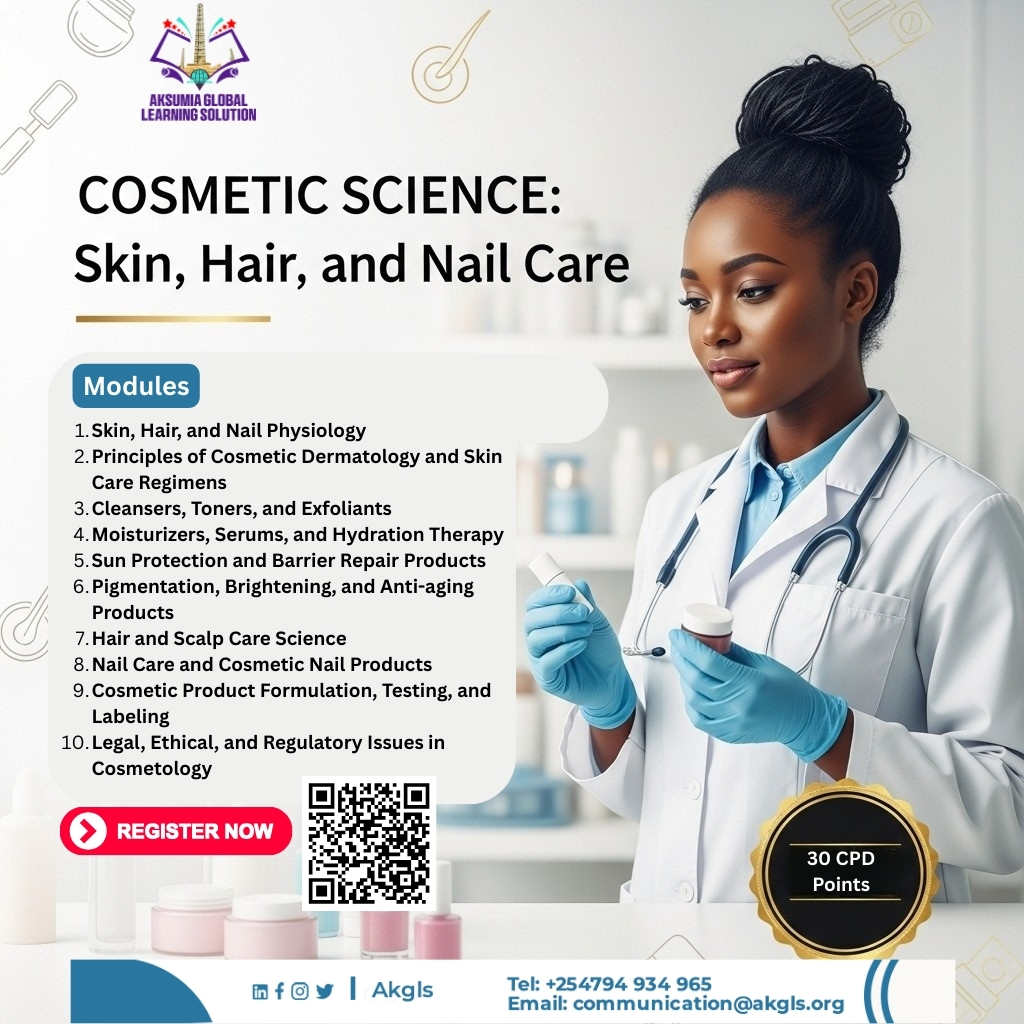
Cosmetic Science: Skin, Hair, and Nail Care
Total Duration: 65 hours
Live Online Sessions: 20 hours
Self-Paced Learning: 40 hours
Pre/Post-Tests: 2 hours
Training Fee: 40 USD
Join Course

COSMETIC SCIENCE: SKIN, HAIR, AND NAIL CARE

( 5.0 )
Overview

The Cosmetic Science: Skin, Hair and Nail care Short Course is specially designed to equip pharmacists, dermatology nurses, estheticians, beauty professionals, and allied health practitioners with the scientific foundation and practical skills required for excellence in skin, hair, and nail care. Developed in collaboration with global experts in cosmetic dermatology, formulation science, and aesthetic practice.

ICT Requirements

  • Computer/Laptop with Microphone & Camera in working condition
  • Good Internet connection
  • Access to Google Forms/MS Forms
  • Ability to perform basic MS Word and Excel functions
Learning Outcomes

Upon successful completion of this course, participants will be able to:

  • Describe the anatomical and physiological structure of the skin, hair, and nails, including variations across different populations
  • Differentiate between various skin, hair, and nail types and conditions to inform product and regimen selection
  • Analyze the functions and mechanisms of cosmetic ingredients used in skincare, haircare, and nail products
  • Evaluate cosmetic product labels, formulations, and marketing claims based on scientific and regulatory standards
  • Design personalized cosmetic care regimens addressing hydration, cleansing, sun protection, pigmentation, and anti-aging needs
  • Recommend appropriate cosmetic procedures and over-the-counter products for common aesthetic concerns
  • Apply legal, ethical, and hygiene principles in the delivery of safe and professional cosmetic care
  • Communicate evidence-based guidance to clients or patients regarding skincare routines, hair/scalp care, and cosmetic nail practices
Assessment

Throughout the training program, various assessment techniques will be employed:

Pre-Test: Baseline knowledge assessment

Continuous Assessment: Online quizzes and short exercises; Participation in theoretical and practical sessions

Case Studies: Real-world scenarios for practical application

Self-Paced Learning Tests: Hosted on the LMS for additional practice

Post-Test: Comprehensive final evaluation

Passing Criteria

To qualify for a certificate of competence, candidates must achieve a minimum passing score of 80% or above on the post-test administered at the end of the training.

Target Audience

This course is designed for pharmacists, dermatology nurses, estheticians, beauty professionals, cosmetic formulators, medical doctors, and allied health practitioners who are involved in skincare, cosmetic dermatology, product formulation, or client consultation.

Training Modality

Delivery Mode: Blended learning, Online live sessions, LMS for self-paced content.

Training Fee: 40 USD (5,000 KSh)

Curriculum
Course Description

This foundational module introduces participants to the anatomy and physiology of the skin, hair, and nails—the primary structures targeted in cosmetic science. It examines their biological composition, key functions, and variations across populations. Learners will gain a scientific understanding of how these structures respond to cosmetic products, treatments, and environmental influences, forming a critical base for all subsequent modules.

Learning Outcomes

By the end of this module, participants will be able to:

  • Describe the structural and functional organization of skin, hair, and nails.
  • Explain how physiological variations affect cosmetic product performance.
  • Identify major skin types and conditions relevant to cosmetic formulation and care.
  • Recognize ethnic and individual differences influencing product selection.
  • Integrate scientific knowledge into safe and effective cosmetic recommendations.
Contents to Cover
  • Skin Structure and Function: Layers of the skin, skin appendages, major roles
  • Skin Barrier and Microbiome: Structure and function of the skin barrier, Transepidermal Water Loss (TEWL), acid mantle and pH balance
  • Skin Typing and Conditions: Common skin types, Fitzpatrick skin types, physiological variations
  • Hair Biology: Hair anatomy, hair growth cycle, ethnic and genetic variations
  • Nail Anatomy and Physiology: Nail components, growth rate, common cosmetic and physiological nail concerns
Course Description

This module provides a scientific understanding of the chemical foundations of cosmetic formulations. It covers the classification, properties, functions, and safety profiles of commonly used cosmetic ingredients across skin, hair, and nail care products.

Learning Outcomes

By the end of this module, participants will be able to:

  • Explain the chemical basis and functional roles of key cosmetic ingredients.
  • Identify and classify cosmetic chemicals by function.
  • Evaluate the physicochemical properties that influence formulation performance and product stability.
  • Discuss safety considerations, allergenicity, and regulatory requirements for cosmetic ingredients.
  • Correlate ingredient selection with product function, texture, and sensory outcomes.
Contents to Cover
  • Introduction to Cosmetic Chemistry
  • Surfactants and Emulsifiers
  • Emollients, Humectants, and Occlusives
  • Preservatives and Antioxidants
  • Active Cosmetic Ingredients
  • Colorants, Fragrances, and Sensory Modifiers
  • Thickeners, Stabilizers, and Solvents
  • Safety, Toxicology, and Regulatory Aspects
  • Trends in Green and Sustainable Cosmetic Chemistry
Course Description

This module introduces participants to the scientific and professional foundations of cosmetic dermatology, emphasizing the relationship between dermatologic principles and the cosmetic industry. Learners will explore how dermatology informs cosmetic formulation, product classification, safety, and ethical practice.

Learning Outcomes

By the end of this module, participants will be able to:

  • Explain the scope and relevance of cosmetic dermatology in professional practice.
  • Differentiate cosmetic from medical dermatology and outline their areas of overlap.
  • Identify and describe common cosmetic dermatologic concerns and their management options.
  • Discuss the use of dermocosmetics and cosmeceuticals in evidence-based treatment.
  • Evaluate the safety, ethical, and regulatory aspects of cosmetic dermatology practice.
Contents to Cover
  • Introduction to Cosmetic Dermatology
  • Common Cosmetic Dermatologic Concerns
  • Dermocosmetics and Cosmeceuticals
  • Topical Agents and Treatment Integration
  • Integrative and Procedural Dermatology
  • Regulatory and Ethical Practice
Course Description

This module provides an in-depth exploration of skin care science and the formulation of effective, evidence-based skincare regimens. It equips participants with practical knowledge on assessing skin characteristics, selecting appropriate products, and designing personalized routines for diverse skin types and conditions.

Learning Outcomes

By the end of this module, participants will be able to:

  • Assess skin type and identify key skincare concerns.
  • Select and evaluate skincare products based on their formulation, function, and evidence base.
  • Design and adapt personalized skincare regimens tailored to individual needs and environmental factors.
  • Differentiate between cosmetic-grade and medical-grade skincare formulations.
  • Counsel clients and patients on safe, effective, and sustainable skincare practices.
Contents to Cover
  • Understanding Skin Types and Concerns
  • Components of an Effective Skincare Regimen
  • Morning vs. Night Routines
  • Product Layering and Compatibility
  • Customization and Targeted Care
  • Integrating Prescription and Cosmetic Skincare
  • Patient Counseling and Professional Consultation
Course Description

This module examines the foundation of effective skincare routines — cleansing, toning, and exfoliation. Participants will explore the scientific principles, formulation differences, and functional roles of various product types in maintaining skin health.

Learning Outcomes

By the end of this module, participants will be able to:

  • Differentiate between types of cleansers, toners, and exfoliants based on formulation and function.
  • Recommend appropriate cleansing and exfoliation strategies for diverse skin types and concerns.
  • Evaluate the benefits and limitations of physical and chemical exfoliation methods.
  • Identify contraindications, irritation risks, and strategies to prevent over-exfoliation.
  • Integrate evidence-based cleansing and exfoliation principles into personalized skincare regimens.
Contents to Cover
  • Types of Cleansers: Oil-based cleansers, foaming/gel/cream/micellar cleansers, soap vs. syndet bars
  • Toners and Astringents: Functions and purposes, key ingredients, evolving role of toners
  • Exfoliation Principles: Physical exfoliants, chemical exfoliants, frequency and safety
  • Product Safety and Skin Response: Red flags and contraindications, patch testing, combining exfoliants with other actives
Course Description

This module explores the science and practice of skin hydration, focusing on how moisturizers and serums work to maintain, restore, and optimize skin barrier function. Participants will gain a deep understanding of formulation principles, active ingredient roles, and delivery mechanisms that enhance hydration and improve overall skin health.

Learning Outcomes

By the end of this module, participants will be able to:

  • Explain the physiological basis of skin hydration and the role of the stratum corneum and Natural Moisturizing Factor (NMF).
  • Differentiate between humectants, emollients, and occlusives, and describe their mechanisms of action.
  • Understand how serums enhance active ingredient delivery and complement moisturizers.
  • Design tailored hydration regimens for diverse skin types and conditions.
  • Identify common misconceptions about moisturization and layering techniques, and apply best practices in skincare recommendations.
Contents to Cover
  • Skin Hydration Physiology
  • Types of Moisturizers: Humectants, emollients, occlusives
  • Serums and Delivery Systems
  • Hydration for Different Skin Types and Conditions
  • Misconceptions and Best Practices
Course Description

This module provides comprehensive training on sun protection and skin barrier repair, two cornerstone components of dermatologic and cosmetic skincare practice. Participants will explore the science of ultraviolet (UV) radiation, sunscreen formulation, and barrier physiology to develop evidence-based sun care and recovery strategies.

Learning Outcomes

By the end of this module, participants will be able to:

  • Explain the types of UV radiation and their effects on skin health and aging.
  • Differentiate between physical and chemical sunscreen filters and interpret sunscreen labeling terms such as SPF, PA, and broad-spectrum.
  • Recommend appropriate sunscreen and barrier-repair products for diverse skin types and conditions.
  • Design skincare regimens that combine effective sun protection with barrier restoration.
  • Identify and manage barrier damage due to actives, exfoliation, or environmental stressors safely and effectively.
Contents to Cover
  • Sun Protection Science
  • Sunscreen Types and Ratings
  • Application Guidelines
  • Barrier Repair Products
  • Product Selection and Customization
Course Description

This module provides an in-depth understanding of the cosmetic science behind pigmentation and skin aging management. It explores the physiological basis of pigment formation, the causes of hyperpigmentation, and the mechanisms of aging, highlighting evidence-based actives that improve skin tone, brightness, and texture.

Learning Outcomes

By the end of this module, participants will be able to:

  • Explain the biological processes underlying pigmentation and skin aging.
  • Identify common causes of pigmentary disorders and age-related skin changes.
  • Evaluate the mechanisms and efficacy of brightening and anti-aging ingredients.
  • Formulate safe and individualized regimens addressing pigmentation and aging across diverse skin tones.
  • Counsel clients on realistic expectations, product safety, and ethical skincare practices.
Contents to Cover
  • Understanding Pigmentation
  • Brightening Agents and Mechanisms
  • Skin Aging and Anti-Aging Mechanisms
  • Anti-Aging Actives and Formulation Science
  • Product Customization and Patient Education
Course Description

This module explores the science and practice of hair and scalp care through the lens of cosmetic dermatology. It combines foundational hair biology with formulation science to help participants understand how to evaluate, recommend, and use hair care products effectively.

Learning Outcomes

By the end of this module, participants will be able to:

  • Describe the structure, composition, and function of the hair shaft and follicle.
  • Explain the phases of the hair growth cycle and recognize related clinical conditions.
  • Differentiate between various hair types and understand ethnic variations influencing care.
  • Identify common scalp disorders and recommend appropriate cosmetic or therapeutic interventions.
  • Evaluate hair care products and advise on proper usage, ingredient awareness, and damage prevention.
Contents to Cover
  • Hair Structure and Function
  • Hair Growth Cycle
  • Hair Types and Ethnic Variation
  • Scalp Health and Common Disorders
  • Hair Product Science
  • Practical Hair Care Guidance
Course Description

This module provides a detailed understanding of nail anatomy, physiology, and cosmetic care, emphasizing safe, evidence-based practices in nail cosmetology. Participants will learn to distinguish between healthy and pathological nail changes, understand the science and formulation of nail products, and implement proper hygiene and safety protocols.

Learning Outcomes

By the end of this module, participants will be able to:

  • Describe the anatomy, structure, and growth process of the nail unit.
  • Identify common cosmetic and medical nail conditions and determine when referral to a healthcare professional is necessary.
  • Evaluate the composition, use, and safety of nail cosmetics, including polishes, gels, and acrylic systems.
  • Apply best practices in hygiene, infection control, and client safety during nail procedures.
  • Provide evidence-based aftercare and client education to maintain nail health and prevent complications.
Contents to Cover
  • Nail Anatomy and Growth
  • Common Nail Conditions
  • Cosmetic Nail Products
  • Hygiene and Safety Practices
  • Client Education and Safe Practice Guidelines
Course Description

This module explores the science, formulation, and safe application of makeup products used for facial aesthetics and enhancement. It blends cosmetic chemistry with artistry—covering product types, ingredient functionality, formulation stability, and hygiene practices.

Learning Outcomes

By the end of this module, participants will be able to:

  • Describe the composition, function, and classification of key makeup products.
  • Differentiate between formulation types and their suitability for different skin types.
  • Explain the role of pigments, binders, and emollients in makeup formulation.
  • Assess product quality, shelf-life, and potential for irritation or contamination.
  • Demonstrate hygienic and professional techniques for makeup application.
  • Advise clients on appropriate product selection and aftercare, ensuring cultural and dermatological appropriateness.
Contents to Cover
  • Fundamentals of Makeup Science
  • Classification of Makeup Products
  • Formulation Science and Ingredients
  • Skin Type and Tone Matching
  • Application Techniques and Tools
  • Product Evaluation and Marketing Ethics
Course Description

This module explores the principles and practices of natural, herbal, and sustainable cosmetic science, focusing on the development and ethical stewardship of eco-conscious beauty products. It introduces participants to plant-based formulations, green chemistry innovations, and sustainable sourcing strategies shaping the modern cosmetic industry.

Learning Outcomes

By the end of this module, participants will be able to:

  • Explain the fundamentals of natural and herbal cosmetic formulation and ingredient selection.
  • Apply principles of green chemistry in cosmetic product design and manufacturing.
  • Evaluate sustainability and ethical sourcing practices in the cosmetic supply chain.
  • Identify eco-friendly packaging technologies and assess their impact on product stability and consumer safety.
  • Advocate for sustainable and ethical standards in cosmetic production, marketing, and consumer education.
Contents to Cover
  • Herbal and Plant-Based Formulations
  • Green Chemistry in Cosmetics
  • Sustainable Sourcing and Eco-Friendly Packaging
Course Description

This module provides a comprehensive introduction to cosmetic product formulation, emphasizing ingredient functionality, formulation design, and product performance. It equips participants with foundational scientific knowledge to understand how cosmetic products are created, stabilized, and optimized for safety, texture, and consumer satisfaction.

Learning Outcomes

By the end of this module, participants will be able to:

  • Identify and describe the key components of cosmetic formulations and their roles.
  • Differentiate between common formulation types such as emulsions, gels, serums, and balms.
  • Explain formulation variables affecting stability, compatibility, and sensory characteristics.
  • Understand the importance of stability and preservative testing in cosmetic development.
  • Evaluate formulation safety and performance from a scientific perspective.
Contents to Cover
  • Fundamentals of Cosmetic Formulation
  • Ingredient Functionality and Compatibility
  • Formulation Design and Optimization
  • Stability and Safety Testing
Course Description

This module explores the regulatory, ethical, and labeling framework governing cosmetic products. It provides participants with the knowledge to interpret cosmetic product labels, understand global compliance standards, and differentiate between cosmetic, drug, and cosmeceutical categories.

Learning Outcomes

By the end of this module, participants will be able to:

  • Interpret cosmetic labels using the INCI system and global regulatory guidelines.
  • Understand the distinction between cosmetic, drug, and cosmeceutical classifications.
  • Explain Good Manufacturing Practice (GMP) requirements in cosmetics.
  • Identify and apply local and international cosmetic regulations.
  • Critically assess cosmetic product claims, labeling accuracy, and compliance documentation.
Contents to Cover
  • Cosmetic Labeling Standards
  • Regulatory Framework and Product Classification
  • Quality and Safety Compliance
  • Label Interpretation and Consumer Education
Course Description

This module explores the legal, ethical, and professional standards that guide cosmetic practice. It emphasizes practitioner accountability, client safety, and truthful communication. Participants will learn how to operate within their legal scope of practice, maintain high ethical standards, and ensure compliance with relevant regulatory frameworks.

Learning Outcomes

By the end of this module, participants will be able to:

  • Explain the legal and licensing requirements governing cosmetic practice within local and international contexts.
  • Apply ethical principles—autonomy, beneficence, non-maleficence, and justice—in daily cosmetic procedures and decision-making.
  • Develop informed consent processes that respect client autonomy and ensure transparency about risks and outcomes.
  • Implement infection control and hygiene protocols that comply with public health and safety regulations.
  • Evaluate the ethical and legal boundaries of cosmetic product advertising and influencer marketing.
  • Demonstrate professional conduct, cultural sensitivity, and effective complaint resolution strategies in client interactions.
Contents to Cover
  • Licensing and Regulatory Compliance
  • Ethical Practice in Cosmetology
  • Product Advertising and Claims
  • Infection Control and Safety Protocols
  • Professional Boundaries and Conduct
When would you like to start?

Start straight away and join a global classroom of learners. If the course hasn't started, yet you'll see the future date listed below.

Join Today Available now